Kaggaladu: Phase 2 visit 3 - The birds are here!


Date of visit: 14th Feb 2010

We had been informed by the teachers of the government school at Kaggaladu oner phone that the arrival of the birds had been delayed this year, which was worrying. They usually arrive by the end of December, whereas this time they arrived early February. But they did come, and so we visited the village that had been chosen by the birds for reasons that are not very clear.

What a sight they are! This was the first time I saw them personally, and I realized why they are called painted storks. Vividly coloured beautiful big birds sitting aplenty on top of those five trees they use every year for nesting. We counted an approximate of 150 birds.


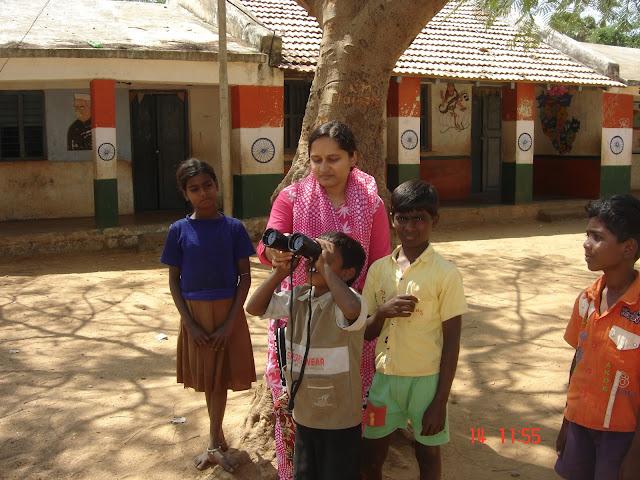
We received a heartwarming welcome by the kids of the school, who were playing around. They remembered our names too! We handed over photographs of the school that we had taken on our previous visit and the children were thrilled. After that, we settled down in a comfortable shady place in the school premises to watch the birds. Binoculars were also used. Time just flew watching the birds perch on the tree tops and fly around.


One bad news was that the lakes were in bad condition with no water in either of the 2 lakes in that village, which meant that the birds would have to do a bit of extra flying in search of food. We do not have adequate statistics to compare our bird count with those that may have been done in previous years, but we hope to keep a tab on it. After a walk around the dried lake, we were offered tender coconuts by a local friendly farmer. A great trip all in all.

Seeing those birds is really something special. I felt an attachment to them as soon as I saw them and Swapna seconded my view on this, stating that she had felt a similar feeling when she had seen them for the first time. These birds have made a long journey to get here after all!

Team members who visited: Swapna and Adithya

To view more pictures of the birds, use this link: http://picasaweb.google.com/lets.integrate.for.environment/Kaggaladu14Feb2010#

SPS Eco-club - Session on waste auditing


Date of event: 23 Jan 2010

Venue: Siddaganga Public School

Team members from LIFE conducted another session on the issue of Waste with SPS eco-club members. The exercises we conducted were: a transect walk in and around the school to identify primary issues with waste in the school vicinity, a basic discussion on waste segregation and also about home-based waste auditing process.
The 40 or so kids from the 6th to the 9th grade were split into three groups and were taken for the observation exercise (transect walk) to 3 different areas around the school, and they were then encouraged to present their findings with the other groups. The key observations included:
-lack of dustbins
-spilling waste in empty plots
-burning of wastes
-toxic wastes etc

The complete report of the exercise will be written by the student volunteers and we will post that here once available to us.
Some home-work has been given to the members and it is just to conduct a basic waste-audit at their respective homes over a 2 week period. The children participated enthusiastically in the event and more students from the school want to join the club now. Some have suggested that they would enjoy a summer camp with the eco-club, which is something we will consider with the teachers of the school.
Pictures of the event will be uploaded soon.
Team members who participated: Swapna, Harsha, Adithya and Phaniraj

LIFE Stall at Deccan rock 2009


Deccan rock 2009

Metal bands enthralled fans at Deccan rock musical fest with promoting awareness on global warming. Event was promoted by Livegig and Orka with CRE on Dec 5th afternoon and international heavy metal bands like Amon Amarth, Textures and Indian bands like Kryptos, Undying Inc, Inner sanctum, Bhyanak Maut and Demonic resurrection performed. The music was thunderous and the fans as well.

NGOs like LIFE, IYCN, Greenpeace and Reva displayed stalls. Life displayed various messages on the global warming effects and indoor plants. As we had younger crowd, we could send the messages of minimal usage of plastics and importance of planting. Also people were more interested learn more on global warming due to upcoming “Copenhagen climate conference” which is a hot and important for all of us.

Below is the detail of media coverage:

http://bangalore.citizenmatters.in/articles/view/1618-metal-festival-climate-change-deccan-rock

Thanks to Sowmya for providing stall for us.

Participants: Aditya, Swapna and Harsha.

What was decided at Copenhagen

Briefing the press at the end of the two-week conference, Yvo de Boer said an accord has been reached that has significant elements, but that is not legally binding.

He described the accord as “politically important,” demonstrating a willingness to move forward. It brings together a diversity of countries that have put in place a letter of intent with the ingredients of an architecture for a response to climate change.

The key points of the accord include the objective to keep the maximum temperature rise to below 2 degrees Celsius; the commitment to list developed country emission reduction targets and mitigation action by developing countries for 2020; USD 30 billion short-term funding for immediate action till 2012 and USD 100 billion annually by 2020 in long-term financing, as well as mechanisms to support technology transfer and forestry.

The challenge now is to turn what is agreed into something that is legally binding in Mexico one year from now.

COPENHAGEN COP15 ACCORD

1. We underline that climate change is one of the greatest challenges of our time. We emphasise our strong political will to urgently combat climate change in accordance with the principle of common but differentiated responsibilities and respective capabilities. To achieve the ultimate objective of the Convention to stabilize greenhouse gas concentration in the atmosphere at a level that would prevent dangerous anthropogenic interference with the climate system, we shall, recognizing the scientific view that the increase in global temperature should be below 2 degrees Celsius, on the basis ofequity and in the context of sustainable development, enhance our long-term cooperative action to combat climate change. We recognize the critical impacts of climate change and the potential impacts of response measures on countries particularly vulnerable to its adverse effects and stress the need to establish a comprehensive adaptation programme including international support.
2. We agree that deep cuts in global emissions are required according to science, and as documented by the IPCC Fourth Assessment Report with a view to reduce global emissions so as to hold the increase in global temperature below 2 degrees Celsius, and take action to meet this objective consistent with science and on the basis of equity. We should cooperate in achieving the peaking of global and national emissions as soon as possible, recognizing that the time frame for peaking will be longer in developing countries and bearing in mind that social and economic development and poverty eradication are the first and overriding priorities of developing countries and that a low-emission development strategy is indispensable to sustainable development.
3. Adaptation to the adverse effects of climate change and the potential impacts of response measures is a challenge faced by all countries. Enhanced action and international cooperation on adaptation is urgently required to ensure the implementation of the Convention by enabling and supporting the implementation of adaptation actions aimed at reducing vulnerability and building resilience in developing countries, especially in those that are particularly vulnerable, especially least developed countries, small island developing States and Africa. We agree that developed countries shall provide adequate, predictable and sustainable financial resources, technology and capacity-building to support the implementation of adaptation action in developing countries.
4. Annex I Parties commit to implement individually or jointly the quantified economy-wide emissions targets for 2020, to be submitted in the format given in Appendix I by Annex I Parties to the secretariat by 31 January 2010 for compilation in an INF document. Annex I Parties that are Party to the Kyoto Protocol will thereby further strengthen the emissions reductions initiated by the Kyoto Protocol. Delivery of reductions and financing by
developed countries will be measured, reported and verified in accordance with existing and any further guidelines adopted by the Conference of the Parties, and will ensure that accounting of such targets and finance is rigorous, robust and transparent.
5. Non-Annex I Parties to the Convention will implement mitigation actions, including those to be submitted to the secretariat by non-Annex I Parties in the format given in Appendix II by 31 January 2010, for compilation in an INF document, consistent with Article 4.1 and Article 4.7 and in the context of sustainable development. Least developed countries and small island developing States may undertake actions voluntarily and on the basis of support. Mitigation actions subsequently taken and envisaged by Non-Annex I Parties, including national inventory reports, shall be communicated through national communications consistent with Article 12.1(b) every two years on the basis of guidelines to be adopted by the Conference of the Parties. Those mitigation actions in national communications or otherwise communicated to the Secretariat will be added to the list in appendix II. Mitigation actions taken by Non-Annex I Parties will be subject to their domestic measurement, reporting and verification the result of which will be reported through their national communications every two years. Non-Annex I Parties will communicate information on the implementation of their actions through National Communications, with provisions for international consultations and analysis under clearly defined guidelines that will ensure that national sovereignty is respected. Nationally appropriate mitigation actions seeking international support will be recorded in a registry along with relevant technology, finance and capacity building support. Those actions supported will be added to the list in appendix II. These supported nationally appropriate mitigation actions will be subject to international measurement, reporting and verification in accordance with guidelines adopted by the Conference of the Parties.
6. We recognize the crucial role of reducing emission from deforestation and forest degradation and the need to enhance removals of greenhouse gas emission by forests and agree on the need to provide positive incentives to such actions through the immediate establishment of a mechanism including REDD-plus, to enable the mobilization of financial resources from developed countries.
7. We decide to pursue various approaches, including opportunities to use markets, to enhance the cost-effectiveness of, and to promote mitigation actions. Developing countries, especially those with low emitting economies should be provided incentives to continue to develop on a low emission pathway.
8. Scaled up, new and additional, predictable and adequate funding as well as improved access shall be provided to developing countries, in accordance with the relevant provisions of the Convention, to enable and support enhanced action on mitigation, including substantial finance to reduce emissions from deforestation and forest degradation (REDD-plus), adaptation, technology development and transfer and capacity-building, for enhanced implementation of the Convention. The collective commitment by developed countries is to provide new and additional resources, including forestry and investments through international institutions, approaching USD 30 billion for the period 2010 – 2012 with balanced allocation between adaptation and mitigation. Funding for adaptation will be prioritized for the most vulnerable developing countries, such as the least developed countries, small island developing States and Africa. In the context of meaningful mitigation actions and transparency on implementation, developed countries commit to a goal of mobilizing jointly USD 100 billion dollars a year by 2020 to address the needs of developing countries. This funding will come from a wide variety of sources, public and private, bilateral and multilateral, including alternative sources of finance. New multilateral funding for adaptation will be delivered through effective and efficient fund arrangements, with a governance structure providing for equal representation of developed and developing countries. A significant portion of such funding should flow through the Copenhagen Green Climate Fund.
9. To this end, a High Level Panel will be established under the guidance of and accountable to the Conference of the Parties to study the contribution of the potential sources of revenue, including alternative sources of finance, towards meeting this goal.
10. We decide that the Copenhagen Green Climate Fund shall be established as an operating entity of the financial mechanism of the Convention to support projects, programme, policies and other activities in developing countries related to mitigation including REDD-plus, adaptation, capacity-building, technology development and transfer.
11. In order to enhance action on development and transfer of technology we decide to establish a Technology Mechanism to accelerate technology development and transfer in support of action on adaptation and mitigation that will be guided by a country-driven approach and be based on national circumstances and priorities.
12. We call for an assessment of the implementation of this Accord to be completed by 2015, including in light of the Convention’s ultimate objective. This would include consideration of strengthening the long-term goal referencing various matters presented by the science, including in relation to temperature rises of 1.5 degrees Celsius.


reference:-http://unfccc.int

Inauguration of Eco-club at SPS


Date of event: 21st November, 2009

As mentioned in an earlier post, LIFE has decided to assist the teachers at Siddaganga Public School, Nagarbhavi in organising the eco-club activities for the school. On the 21st of November the eco-club was formally inaugurated for 40 interested children from 6th to 9th class.
After the initial ceremony, we conducted a one-hour interactive session with the children about issues with plastic waste disposal, including recycling, health effects and ideas to reduce. This was done as a follow up session after the school-visit to K K Plastics. Swapna spoke about the options for recycling of plastics and Adi spoke about the health effects that arise from stage of production to stage of disposal of plastics.
The movie "Story of Stuff" was also shown to the audience.
Few innovations made from "waste" plastic were also showcased to light the spark of creative use of waste in children. This included a used oil-can made into a container with an indoor plant.


The response from the teachers and students was encouraging. A suggestion was that "Story of Stuff" be dubbed into Indian accent so that the children can follow it better and also to make the session more activity based. Another suggestion was to reduce the dependency on Powerpoint presentations. These have been well taken.

We have given some work to the students of the club for the next month, including conducting waste segregation and audit at homes and school and suggestions for creative use of waste plastic.

The next session will be in January 2010, where a field trip may be organised for the children.

Participating members:
Harsha, Swapna, Adithya, Shreeshail and Rajeshwari

Stall at RVCE


Date of event: 15th November 2009

The occasion was the cultural fest at RV College of Engineering. This year's theme was environmental awareness and we were invited to organise a stall at the college premises.


What was on display:
There were no items for sale, only for display. Posters were arranged along the sidewalls of the stall (These were borrowed from Community Health Cell). Indoor potted plants made from recycled products were also displayed. Many books and magazines on environmental themes were also arranged. Reusable bags made of cloth were also hung along with the posters.

Objective:
To interact with interested students and network. Also to showcase lifestyle change options and recommended reading material for the youth.

The experience:
It was the first time we set up an awareness stall at a college fest. With the young men and women busy taking part in and watching the events and also each other (lol), the response was meagre. Also, we realised that if attention has to be drawn, something exciting has to be arranged. Maybe next time we will include some games/videos/music and get them involved with puzzles. But it was a good learning experience on the whole.


Kaggaladu visit: Phase 2 visit 2

Date: November 14th 2009

Members of the core team visited Kaggaladu village on the 14th of Nov to celebrate Childrens Day with the students of the Government School there. We had previously informed the teachers of the school and also the local panchayat leaders that we would like to come and meet them. We were able to board the 6 30 am bus from Bangalore and made it to the school by 9 30 am. After arriving there, we first had a meeting with the teachers, during which we introduced ourselves and made clear our intentions from the visit. The teachers were responsive and showed their interest too in educational activities and in protecting the migratory birds. A monthly visit to Kaggaladu from our side is what we told we'll do. In conversation, we were told by the teachers that water was no longer a problem here because the local lakes were being recharged with water from Hemavathi river. But we have our doubts if that is a viable long term solution. We would be discussing this with panchayati members when we have the chance. Another issue that was highlighted was the lack of sanitation in the village and they have suggested health education classes for children and parents. The teachers expressed a lot of expectation from us, and we assured them that we will do as much as we can to help the school.


The children were assembled onto the grounds of the school and we had a nice ice-breaker session with them. Songs were sung, lots of photos were taken and sweets were distributed. We collected the wrappers from the children to highlight the importance of waste handling.

An activity has been assigned to the kids of 5th to 7th classes. Five KG cardboards, poster paints and crayons have been given to them and we’ve told them to make posters which depict the village, the agriculture, the birds, the water and their school. The posters are to be made ready in a month’s time when we visit next. We’ve promised prizes for the best one. This was given with two main intentions. One is for the kids to appreciate better the village and school, and secondly, to give them opportunities to bring out their creativity in the form of art.

After the school visit we had a brief chat with one of the panchayati leaders. We realized that if anything has to come out of our efforts, continued visits and pressure will be required from our side.

After that we went bird watching. We had received prior information that some storks had already arrived. At a nearby lake we spotted 4 kinds of water birds and probably one painted stork.

Our next visit is planned towards the end of december and another one in Republic Day. By then the birds are expected to have arrived. We hope bird watchers and volunteers would join us next time.

Members who visited: Harsha, Swapna and Adithya

Field trip with children from S P School to K K Plastics


Date: 24th of October, 2009

Place of visit: K K Plastics, off Kanakpura Road, Bangalore

The Principal and staff of Siddaganga Public School had shown great interest in engaging the children of the school in environmental education activities. LIFE has volunteered to help arrange activities on a long term basis at the school and also to initiate an eco-club for students there.
In this regard, we organised a field trip to K K Plastics for students of 8th, 9th and 10th standard. There were a total of 120 kids. K K plastics has become famous over the last few years for the innovative use of excess waste plastic in the development of better quality roads. "Plastic waste roads" can be seen in many places in Bangalore such as Double Road and Cubbon Road. These are innovations by Mr. Rasool Khan of K K Plastics. These roads have the benefit of being three times more durable than traditional tar roads. Also, there is now an alternative way to handle excess plastic waste.
During the one-hour visit, the children were explained the procedure. First the plastic wastes are sorted and cleaned by a machine, then the wastes are dried and sent to the shredding machine which cuts the plastic into small pieces (powder like). The powder is packed and stored in bags till the date for use arrives.

The plan of action now is to discuss with the children the issues of waste, its connection with lifestyle and the possible inadequacy of these type of solutions in the long run.

School postings at:

Members who attended: Swapna, Harsha and Adithya

World climate day 2009


On the occassion of International Day of Climate Action, Indian Association of Energy Management Professionals (IAEMP) in association with LIFE-Bengaluru invite you to an event that could change your thoughts and provide you new ideas on Energy Management in future. Be there!! Details of the event given below:


Theme – To promote Innovation and Entrepreneurship for Energy Efficiency
Date: 24 October 2009, Saturday, 9.30 am
Venue: Surana College, South-end Circle, Jayanagar, Bangalore
Occasion: International Day of Climate Action


The Five Activities


1. Creating a Green World (Poster Drawing Competition)
Suggested Themes for Poster making
• Reduce, reuse and recycle ( Refuse)
• Everything is energy, nothing is waste
• Energy efficiency begins at home ( Charity begins at Home)
• Local action for Global warming ( Think Global Act Local)
• Green Innovation is the path to a better future
• Save a drop, save a watt- avoid planet getting hot
Prizes worth -
- Rs. 7000/-
- Rs. 5000/-
- Rs. 3000/-


2. Green Idea Contest
Send an Idea relevant on Clean Technology or Green Business within 250 words.
One First Prize Rs. 1500/-
Two Second Prizes Rs. 1000/-
Three Third Prize Rs. 500/-


3. Panel Discussion on Green Business by experts


4. Introduction of HEMP, Home Energy Management Program - a presentation
Charity begins at home...


5. Stalls/Demonstrations/Presentations


Contact: Levine Lawrence - 9845535573
Vinod Durge - +91 98452 92557

Visit to Kaggaladu


For those unaware about the village Kaggaladu, and the special interest it bears with migratory birds like the Painted Stork and the Grey Heron, kindly read this from an earlier post titled "Kaggaladu - Habitat conservation". (http://letsintegrateforenvironment.blogspot.com/2009/07/kaggaladu-habitat-conservation.html)

It had been almost a year or more since members of LIFE visited this village. This visit is something we'd been planning for a few months. On the 20th of September, 2009, we made our visit, which we hope would be the first of a long and sustained effort to restore the sanctuary and the lakes of the village.

Our first concern was to check if the five trees on which the birds were nesting last year were still around. Thankfully, they were safe and sound. We spent an hour there talking to the local panchayat members (local governance) about the lakes, the bird population over the year and the efforts of the forest department and other interested groups. It appears that the forest department has been responsive and that the bird population this year was very good.

We didnt sight any of the above mentioned birds though, as this is not the season. We feel that working off-season with the villagers will help build rapport, as this is very essential for sustained activity.

Some watershed development activity has taken place, but the lake still is not able to get recharged fully, so this is another area we will be working on slowly with the concerned department.

When we visit next time, the agenda will be more focussed and it will be a fact finding mission. When we get hard data from the villagers and the government bodies, we'll be in a better position to plan out the events. Also, we plan to involve the local children in the efforts. There are plans to help initiate a library and art facility at the school.

The villagers were cordial and showed their concern for the birds, but it was clear that they do face problems with water availability and poverty. Our efforts will be directed toward holistic sustainable development of the village for the people and the winged visitors.

Team members who went: Swapna, Harsha, Adithya and Shreeshail

Date of visit: 20.09.2009

Kindly find few pics at:
Contact us at: lets.integrate.for.environment@gmail.com